Thursday, January 31, 2019

Flower Songs


Activities directors, caregivers, and healthcare professionals,here is some great information


Here is a great dementia resource for caregivers and healthcare professinals,

Here is a way for nurses administrators, social workers and other health care professionals to get an easyceu or two

Here is information on being the best caregiver you can be


Flower Songs

Al Martino - Tears And Roses (1964)
Henry Mancini - Days Of Wine And Roses (1963)
Andy Williams - Days Of Wine And Roses (1963)
Bobby Darin - 18 Yellow Roses (1963)
The Jaynetts - Sally, Go 'Round The Roses (1963)
Paul Peterson - Lollipops And Roses (1962)
Nat King Cole - Ramblin' Rose (1962)
David Carroll - The White Rose Of Athens (1962)
Billy Vaughn - Orange Blossom Special (1961)
Anita Bryant - Paper Roses (1960)
Marty Robbins - A White Sport Coat (And A Pink Carnation) (1957)
Mitch Miller - Yellow Rose Of Texas (1955)

Percy Wenrich-When You Wore a Tulip

Tuesday, January 29, 2019

Valentine's Day Activities for Those Suffering from Dementia

valentines day vintage lettering background
Activities directors, caregivers, and healthcare professionals,here is some great information

Here is a great dementia resource for caregivers and healthcare professinals,

Here is information on being the best caregiver you can be

With more than 5.5 Americans living with Alzheimer's disease or another dementia, loved ones and healthcare professionals need to take every chance to make the lives of those stricken better and happier.

It is also important that while doing this, you stimulate a dementia sufferer's mind to make his or her decline slower.

What can you do this Valentine's Day that will be engaging, fun and exciting for someone with dementia?

What you do depends a lot on the likes, dislikes and interests of the person with dementia. Make sure you do something fun together, no matter what it is.
First before the holiday even begins, you and persons with dementia can create and send valentines.

If you decide to make the valentines, you can use construction paper, stickers, or doilies. You can precut hearts out of paper if necessary. Then ask the dementia person to place the stickers on the hearts. You may have to hand those with Alzheimer's disease, one sticker at a time. If this is too difficult, just ask the dementia person where the sticker should be placed. You can have fun with the stickers also. Stick one on your nose. Then laugh. As you know laughter is the best medicine.

Use your imagination to come up with other materials you can use to create a valentine such as: magic markers, lace, ribbon, or photographs

Remember even if the valentines do not look that good, it is the process not the product that counts.

In addition, you do not have to make the valentines. You can buy an inexpensive box of valentines. There are many that are appropriate for adults. Encourage those with Alzheimer's disease or a related dementia to sign the cards. Often a person with mid stage dementia can still sign his name. If not, have him just look at the valentines. You can comment on the colors and objects on the valentines. Ask the dementia person what these things remind him of. If he needs help tell him what the objects remind you of


Sunday, January 27, 2019

Weather aesop's fable


Activities directors, caregivers, and healthcare professionals,here is some great information

Here is a great dementia resource for caregivers and healthcare professionals,

Your residents will love the Amazon Kindle Fire

Here is information on being the best caregiver you can be


Here is a way for nurses administrators, social workers and other health care  professionals to get an easyceu or two


Follow alzheimersideas on twitter

The Dementia Caregiver's Little Book of Hope [Kindle Edition]

A fable related to some elements of the weather

The North Wind and the Sun

The North Wind and the Sun disputed as to which was the most powerful, and agreed that he should be declared the victor who could first strip a wayfaring man of his clothes.
The North Wind first tried his power and blew with all his might, but the keener his blasts, the closer the Traveler wrapped his cloak around him, until at last, resigning all hope of victory, the Wind called upon the Sun to see what he could do.
The Sun suddenly shone out with all his warmth. The Traveler no sooner felt his genial rays than he took off one garment after another, and at last, fairly overcome with heat, undressed and bathed in a stream that lay in his path.
Moral: Persuasion is better than Force.

Perfect Valentine gifts for those with dementia


Here is a great dementia resource for caregivers and healthcare professionals,

You will love the Amazon Kindle Fire

Here is information on being the best caregiver you can be

Here is a way for nurses administrators, social workers and other health care professionals to get an easyceu or two

Follow Alzheimers1 on twitter


Over 5.5 million Americans are living with dementia. Is one of them someone you know or work with? Get him/her or anyone with Alzheimer's disease a Valentine's Day gift that will keep on giving long after the holiday is gone.

First on the list of gifts is a book by Susan Berg called Adorable Photographs of Our Baby -- Meaningful, Mind-Stimulating Activities and More for the Memory Challenged, Their Loved Ones and Involved Professionals, This book features baby photographs that seniors with dementia love. This book shares a plethora of ideas and resources for you.

Another gift dementia persons will fancy is a love classic musical video or DVD. They will enjoy watching something from the good old days and singing the songs played throughout the picture. Here are a few suggestions: Singin' in the Rain, Meet Me in St. Louis, or Shall We Dance

Next is a sing a long CD or audio cassette of their favorite love songs. There is a series of these called, Old Time Favorites by Nancy Pitkin

You may want to get a sing a long video where your loved one can see and hear performers singing songs they love and are about love. A good one is, Sing-Along with Phil Bernardi: Songs We Know and Love

Here is another idea. Give a friend with dementia some hand lotion. Any kind will do. Just be aware of any allergies or pain issues he/she might have. If he/she can tolerate it, those with a pleasant scent work well. Give him/her a relaxing hand massage talking about how good the hand massage feels, how much you love this person, and a Valentine's Day experience you both share from the past.

If you cannot afford or do not have time to get these gifts before Valentine's Day, give the gift of yourself. No matter how hard it is for you to visit a dementia person, he/she will appreciate your company even though he/she may not be able to express it. Take him/her for a walk, sing some of your favorite songs together, or share some messages of love. Just spend some quality time with a dementia person. Both of you will feel better. Do remember to be upbeat animated and excited about visiting.

A phone call or a Valentine's card will do if there is no way you can visit in person. At least they will know you are thinking of them. Then visit on another day.

So no matter what you do, do not forget the person with dementia this Valentine's Day because it will make you and him/her feel good. What could be better than that!

Order any of the products mentioned in the article at Amazon.com. Order the book, Adorable Photographs of Our Baby -- Meaningful, Mind-Stimulating Activities and More for the Memory Challenged, Their Loved Ones and Involved Professionals, the audio CDs and cassettes and the videos and DVDs at seabaygame.com

These gifts are simple, inexpensive or free, and can be enjoyed by all

Friday, January 25, 2019

Ground hog's day story

Activities directors, caregivers, and healthcare professionals,here is some great information

Here is a great dementia resource for caregivers and healthcare professionals,

Your residents will love the Amazon Kindle Fire

Here is information on being the best caregiver you can be

Here is a way for nurses administrators, social workers and other health care  professionals to get an easyceu or two

Follow alzheimersideas on twitter

The Dementia Caregiver's Little Book of Hope [Kindle Edition]


A ground hog is a small animal that digs and lives under the ground. It is also called the woodchuck. Ground hogs live in many parts of America. In the winter they hibernate like bears and some other animals.

There is a legend that says a few hundred years ago Europeans brought Ground Hog Day to America. They said that the ground hog wakes up from his hibernation on February 2. (February 2 is half way between winter and spring.) If he comes up from his hole and it is sunny, he will see his shadow and be frightened. If he sees his shadow, there will be 6 more weeks of winter weather. But if he comes up and the sky is cloudy, he will not see his shadow and will not be frightened. Then spring weather will come very soon.

Some people believe this legend and they watch the sky on February 2. Many people are happy if it is cloudy on that day. They think spring will come soon. But most people think it is just a fun legend. What do you think?

More winter weather trivia and ideas


Activities directors, caregivers, and healthcare professionals,here is some great information

Here is a great dementia resource for caregivers and healthcare professionals,

Your residents will love the Amazon Kindle Fire

Here is information on being the best caregiver you can be


Here is a way for nurses administrators, social workers and other health care  professionals to get an easyceu or two


Follow alzheimersideas on twitter

The Dementia Caregiver's Little Book of Hope [Kindle Edition]

Remember February 5 is National Weather Persons' Day

weatherwizkids


Winter Storms
How do winter storms form?
Winter storms derive their energy from the clash of two air masses of different temperatures and moisture levels. Winter storms usually form when an air mass of cold, dry, Canadian air moves south and interacts with a warm, moist air mass moving north from the Gulf of Mexico. The point where these two air masses meet is called a front. If cold air advances and pushes away the warm air, it forms a cold front. When warm air advances, it rides up over the denser, cold air mass to form a warm front. If neither air mass advances, it forms a stationary front.
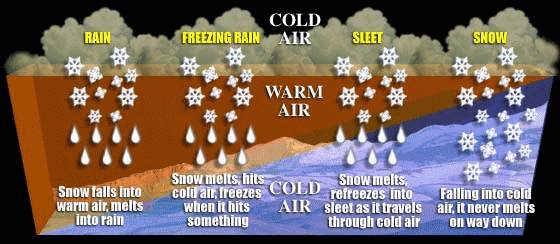

Precipitation Chart

Click Here to see what winter is like where you live.
How is snow formed?
Snow is commonly formed when water vapor undergoes deposition, which is when water vapor changes directly to ice without first becoming a liquid, high in the atmosphere at a temperature of less than 32°F and then falls to the ground.
Snow
How do blizzards form?
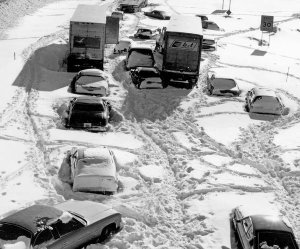
A blizzard is a long-lasting snowstorm with very strong winds and intense snowfall. You need three things to have a blizzard; cold air at the surface, lots of moisture, and lift. Warm air must rise over cold air.
Blizzard
What are snowflakes?
Snowflakes are made of ice crystals. Each snowflake is six-sided and made of as many as 200 ice crystals. Snowflakes form in clouds where the temperature is below freezing. The ice crystals form around tiny bits of dirt that has been carried up into the atmosphere by the wind. As the snow crystals grow, they become heavier and fall toward the ground.
Snowflake


Why is snow white?
Bright snow blinds us with its gleaming white color because it reflects beams of white light. Instead of absorbing light, snow's complex structure prevents the light from shining through its lattice formation. A beam of white sunlight entering a snow bank is so quickly scattered by a zillion ice crystals and air pockets that most of the light comes bouncing right back out of the snow bank. What little sunlight is absorbed by snow is absorbed equally over the wavelengths of visible light thus giving snow its white appearance. So while many natural objects get their blue, red, and yellow colors from absorbing light, snow is stuck with its white color because it reflects light.
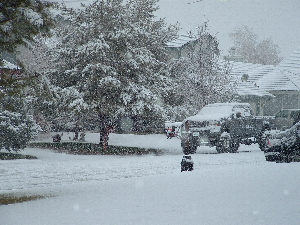
Snow
What is thundersnow?

Thundersnow is when thunder and lighting occur during a snowstorm. This occurs most often in late winter or early spring. To get thundersnow, you need a mass of cold air on top of warm air, plus moist air closer to the ground. Thundersnow starts out like a summer thunderstorm. The sun heats the ground and pushes masses of warm, moist air upward, creating unstable air columns. As it rises, the moisture condenses to form clouds, which are jostled by internal turbulence. The "tricky part" for making thundersnow is creating that atmospheric instability in the wintertime. For thundersnow to occur, the air layer closer to the ground has to be warmer than the layers above, but still cold enough to create snow. During thundersnow events, heavy snowfall is to be expected. In some cases, two inches per hour is possible.
What is sleet?
Sleet is just rain drops that freeze into ice pellets before reaching the ground. Sleet usually bounces when hitting a surface and does not stick to objects. However, it can accumulate like snow and cause a hazard to motorists.
What is freezing rain?
Freezing rain is just rain that falls onto a surface with a temperature below freezing. This causes it to freeze to surfaces, such as trees, cars, and roads, forming a coating or glaze of ice. Even small accumulations of ice can cause a significant hazard.
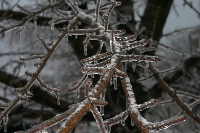
Ice Storm


What is an ice storm?
An ice storm is a type of winter storm caused by freezing rain. The U.S. National Weather Service defines an ice storm as a storm which results in the accumulation of at least 0.25-inch of ice on exposed surfaces.
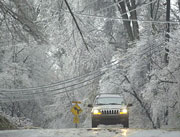
Ice Storm

How do ice storms form?
Ice storms form when a layer of warm air is between two layers of cold air. Frozen precipitation melts while falling into the warm air layer, and then proceeds to refreeze in the cold layer above the ground. This creates freezing rain or a glaze of ice.


What is frost?
Frost is white ice crystals that form on a surface, like the ground or leaves of a plant. Frost is created when the air temperature drops below freezing and the water vapor in the air freezes into ice crystals.


What is a frost quake?
Frost quakes are non-tectonic seismic events, meaning they are not caused by the shifting of the Earth's tectonic plates. Also known as cryoseisms, frost quakes are caused by a sudden rapid freezing of ground and bedrock, usually when temperatures go from above freezing to below zero. As moisture absorbed in the rock and soil freezes, it expands. This puts a great amount of stress on the areas around it. Eventually, the stress is too much and the soil and rock will crack in an "explosive" manner, creating a loud sound and even shaking the ground surface. Since temperatures are coldest in the overnight hours, most people experience frost quakes in the middle of the night.
How is lake-effect snow formed?
As the cold air flows over the warm lake water, the relatively warm water heats the air's bottom layer as lake moisture evaporates into the cold air. Since warm air is lighter or less dense than cold air, the heated air rises and begins to cool. As the air cools, the moisture that evaporated into it condenses and forms clouds and snow begins falling from the cloud if the air is humid enough. (Graphic Credit: USA TODAY.)
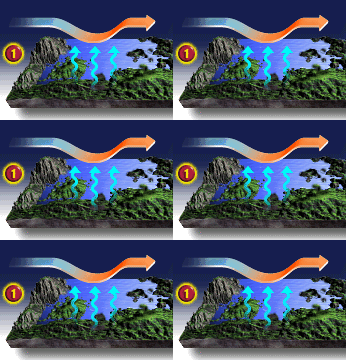
Lake-Effect SnowLake-Effect Snow
OneCold air moves over warm water and is warmed from below. Moisture evaporates in the air.TwoWarm moist air rises downwind of lakes and forms heavy snow.

What is a Nor'easter? Nor'easters can occur in the eastern United States any time between October and April, when moisture and cold air are plentiful. A Nor'easter is named for the winds that blow in from the northeast and drive the storm up the east coast along the Gulf Stream, a band of warm water that lies off the Atlantic coast. They are known for dumping heavy amounts of rain and snow, producing hurricane-force winds, and creating high surfs that cause severe beach erosion and coastal flooding.

What is an Alberta Clipper?
An Alberta clipper is an area of low pressure that generally forms over Alberta, Canada, east of the Rocky Mountains. They develop east of the Rockies because air flowing eastward over the mountains creates favorable conditions. Once an Alberta Clipper forms it usually moves very rapidly to the southeast across the USA's northern Plains and then to the east off the mid-Atlantic Coast. Clippers usually cause only light precipitation with very few producing major snowstorms. However, if conditions are favorable, some Alberta clippers can rapidly intensify off the East Coast once the storm taps the relatively warm moist air over the Atlantic Ocean. The storms that rapidly intensify sometimes spread heavy snow over New England and southeastern Canada. Generally, the main weather features associated with Alberta clippers are some light snow and a reinforcement of cold air over the USA.
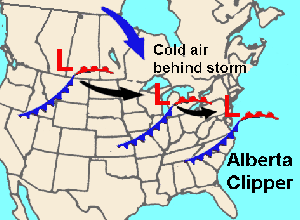
Alberta Clipper

What is Wind Chill?

The wind chill is the temperature your body feels when the air temperature is combined with the wind speed. The higher the wind speed the faster exposed areas of your body lose heat and the colder you feel.
Windchill
Click Here to calculate the Wind Chill.

What is frostbite?
Frostbite is damage to the skin due to prolonged exposure to cold temperatures, usually below 32° F.
What is an avalanche?
An avalanche is a moving mass of snow that may contain ice, soil, rocks, and uprooted trees. The height of a mountain, the steepness of its slope, and the type of snow lying on it all help determine the likelihood of an avalanche. Avalanches begin when an unstable mass of snow breaks away from a mountainside and moves downhill. The growing river of snow picks up speed as it rushes down the mountain. Avalanches have been known to reach speeds of 245 miles an hour (394 kilometers per hour)—about four times as fast as the speediest downhill skier.
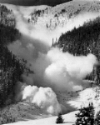
Avalanche
Click Here to learn more about Avalanche Saftey.

Snowflake Know the Lingo Snowflake
WINTER WEATHER ADVISORIES - Issued for accumulations of snow, freezing rain, freezing drizzle, and sleet which will cause significant inconveniences and, if caution is not exercised, could lead to life-threatening situations. WINTER STORM WATCH - Alerts the public to the possibility of a blizzard, heavy snow, heavy freezing rain, or heavy sleet. Winter Storm Watches are usually issued 12 to 48 hours before the beginning of a winter storm.
WINTER STORM WARNING - Issued when hazardous winter weather in the form of heavy snow, heavy freezing rain, or heavy sleet is occurring. Winter Storm Warnings are usually issued 12 to 24 hours before the event is expected.
BLIZZARD WARNING - Issued for sustained or gusty winds of 35 mph or more, and falling or blowing snow creating visibilities at or below 1/4 mile. These conditions should persist for 3 hours.
FROST/FREEZE WARNING - Issued when below freezing temperatures are expected.
LAKE EFFECT SNOW ADVISORY - Issued when accumulation of lake effect snow will cause significant inconvenience.
LAKE EFFECT SNOW WARNING - Issued when heavy lake effect snow is occurring.
WIND CHILL ADVISORY - Issued when the wind chill temperature is forecast to be between -15°F to -24°F.
WIND CHILL WARNING - Issued when the wind chill temperature is forecast to be -25°F or lower.
Click Here to see if there are any active warnings in your area.

Snowflake Winter Storm Safety Tips Snowflake
BEFORE A WINTER STORM: Have a disaster plan and prepare a disaster supplies kit for your home and car. Include a first aid kit, emergency food supply, bottled water, battery-operated radio, flashlight, protective clothing, and blankets. Don't forget, be aware of changing weather.


DURING A WINTER STORM: Stay indoors and dress warmly. Eat regularly, because food provides the body with energy for producing its own heat. Also, drink lots of water. If you must go outside, wear layered clothing, mittens and a hat. Watch for signs of hypothermia and frostbite. Remember to keep dry. Always change wet clothing to prevent the loss of body heat. If you must drive, carry a cell phone. Always, keep the gas tank full. Don't forget, let someone know where you’re going, just in case your car gets stuck. If you’re car gets stuck, stay with it and wait for help unless help is visible within 100 yards. Use maps and car mats to stay warm.

AFTER A WINTER STORM: Avoid driving until conditions have improved. Avoid overexertion! Heart attacks from shoveling snow are the leading cause of deaths during the winter. Also, check on neighbors to make sure they're okay.

Wednesday, January 23, 2019

Weather trivia

Activities directors and other healthcare professionals here is a great dementia resource for caregivers and healthcare professionals.


Here is information on being the best 
caregiver you can be

Here is a way for nurses administrators, social workers and other health care  professionals to get an easyceu or two

Follow alzheimersideas on twitter

The Dementia Caregiver's Little Book of Hope [Kindle Edition]

February 5 is National Weather Persons' Day

Lovetoknow

Weather Trivia

Did you know:
  • It can be as warm as 40 degrees on the ground and still snow.
  • According to the "Guinness Book of World Records," the biggest snowflake on record occurred in Montana in 1887. It was eight inches by 15 inches.
  • The record for the most snow fall in a 24 hour period in the United States happened in Silver Lake, Colorado in 1921. During that 24 hour period, six feet and four inches of snow fell--which is the height of a very tall man!
  • While you may have heard someone say, "It's too cold to snow," there is no truth to this. Snow can always fall if it is cold out and there is moisture in the air.
  • The coldest temperature ever recorded on Earth was -128 degrees. The temperature was measured on Antarctica in 1983.
  • Every snowflake has six sides.
  • The Abominable Snowman is more than an invention of a television Christmas special. While there is no proof that it exists, many people believe that the Yeti, or an abominable snowman, lives in the Himalayas in Nepal. The word Yeti means snow bear, and many people believe the Yeti is related to Bigfoot.